

 35 / 64

Customer Care 0800 192 783
clientservices@enviroserv.co.za www.enviroserv.co.zaTANK CLEANING
ATTRIBUTES
The scope of tank cleaning typically involves de-sludging, flushing and HP
cleaning of a tank’s internal surfaces in preparation for NDT inspection
and weld repairs. A turnkey solution to tank cleaning involves tank entry
followed by removal, transportation and safe disposal of waste including
tank sludge, waste-water and maintenance waste generated throughout
the project.
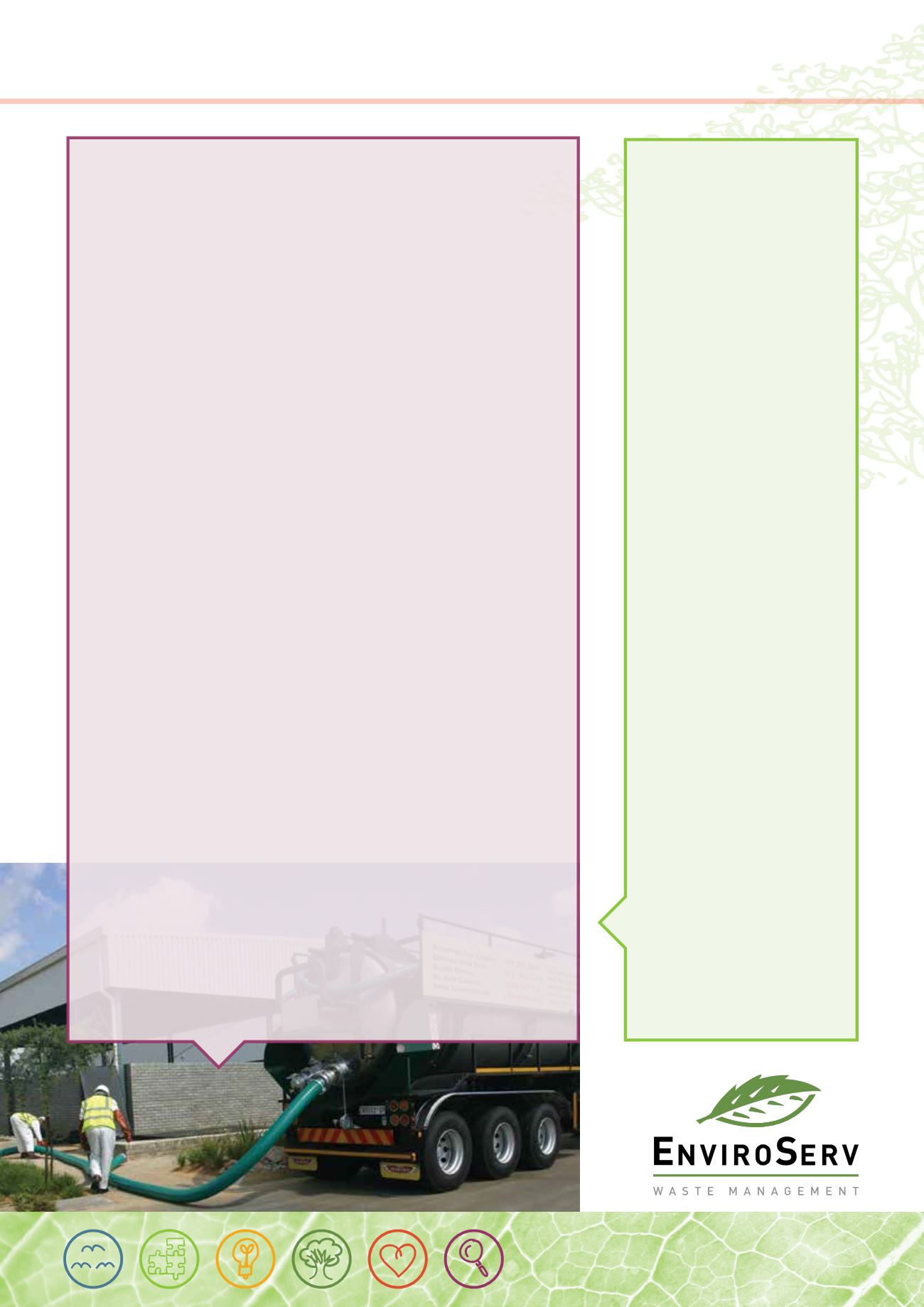
Various methods of tank cleaning range from manual labour to meth-
ods supported by the use of standalone vacuum pumps, vacuum trucks,
pumps and mini-dozers. Skilful operation and use of these methods are
essential for safe and effective execution of a tank cleaning project. Cost
efficiency and timeline efficiency is achieved through the use of bulk lo-
gistics for the transportation of waste sludge. The design of our custom-
ized fleet of fit for purpose road tankers comprise of hydraulic opening
back-ends for quick tipping and disposal of sludges. Our tankers can be
pumped or vacuumed into and can carry a payload capacity of up to 30m
3
.
Our mobile vacuum trucks (Super Suckers) are also available in payload
capacities ranging from 10m
3
to 20m
3
.
In addition to the cleaning of tanks containing liquids and sludges, we
are also able to clean vessels of other kinds effectively. Our vacuum units
have been used to clean out driers, absorbers, reactor vessels and packed
columns and to remove spent catalyst and other solid materials.
Improper cleaning of a tank could delay the entire project timeline for tank
maintenance, or interfere with accurate results from NDT inspection. More
seriously, failing to remove all significant residues from a tank could have
potentially fatal consequences during subsequent hot work such as grind-
ing, cutting and welding.
Safe execution of tank cleaning work requires strict compliance to safety
regulations governing confined space entry and the handling of hazardous
substances. Compliance to these regulations depends on the level of train-
ing, discipline and supervision of the personnel involved and is enabled
through the provision of suitable personal protective equipment. Confined
space entry involves many critical sub-tasks such as venting, gas testing,
supply and use of breathing apparatus, safety standby and rescue proce-
dures. Our experience in the South African and southern African regions
revealed that customers have varying levels of involvement in these activi-
ties and we have collaborated effectively with all of the downstream oil
and gas market players in the region. Compliance with customer-specific
site regulations is as important as compliance with legal requirements.
Contractor files and safety files are prepared in accordance with relevant
legislation and the customer’s health and safety specification.
BENEFITS
• Peace of mind that work
is being conducted by
competent people with
minimum delays.
• Ability to deliver services
outside of South African
borders.
• EnviroServ can provide
many of the ancillary
services around tank
cleaning like industrial
vacuuming and disposal
of waste residues.
• EnviroServ has the ability
to choose and apply the
right equipment suited to
each type of job.
• In most instances we will
already have extensive
experience relating to the
work required and can
advise the client on the
best approach to follow.
• Our specialist can quote
on what work will be
required to complete the
work required including all
safety and occupational
health requirements.
• We have extensive
experience meeting
SHEQ requirements
including that of the many
multinationals we serve,
with Safety and Health
plans prepared ahead of
any complex work being
done.